

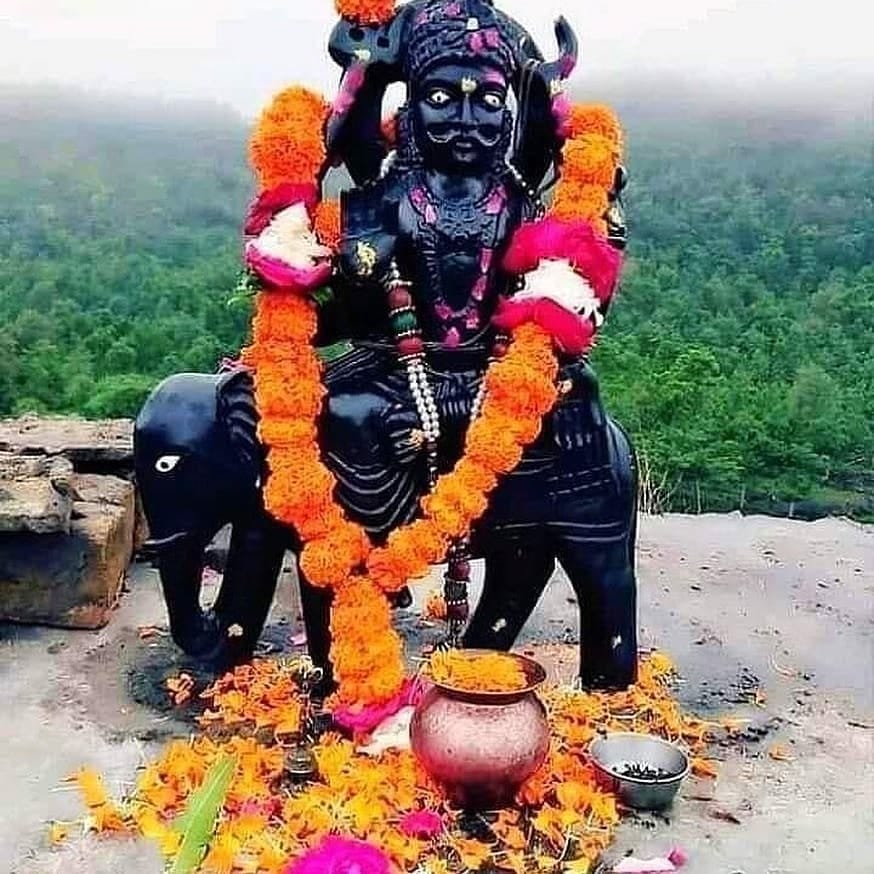
“Aum Aing Hring Shring Shung Shanaishcharaayai Namah: Aum”
“The Shani Mahatmya” or the “Greatness of Saturn”, is the source book
for most of our information concerning the great god, Shani Deva. Most of
Bharat’s puranic stories are meant to convey cosmological data, archetypal
material, cultural and social taboos, medical information and spiritual and
mystical matters to those who know how to access it. Even if you don’t fully
understand them, stories like “The Greatness of Saturn”, can help to cure
you of many psychological difficulties leading to physical ones.
Vedic Astrology is totally based on Astronomy or Kaagol Shastra, which
was a very highly evolved science in ancient India. Therefore, it is most
scientific and is known as Jyotish Shastra. There are nine planets in our
solar system that have a great influence on our lives even though we do not
realise it. In fact, every day of our week is named after one of the planets.
Of course Surya or the sun is the chief of these planets since he is the centre
of our solar system. The names of the days of our week correspond to the
seven main planets. Sunday is the sun’s day as we can guess, Monday is the
day for the moon or Soma, Tuesday belongs to Mars or Mangal,
Wednesday is the day for Mercury or Budha, Thursday is the day for Guru
or Jupiter, Friday for Shukra or Venus and Saturday for Saturn or Shani.
The other two planets are called Rahu and Ketu and they are only shadow
planets or the ascending and descending nodes of the moon. Actually only
three of these planets have beneficial effects on us. These are Guru -
Brihaspati or Jupiter, Shukra or Venus and Buddha or Mercury. The
other four are malefic. Of these four, Shani or Saturn is the most feared.
Shani occupies the seventh place among the nine planets which govern the
world. This is viewed as unlucky in conventional astrology. Astrologically,
the planet Saturn is the slowest of the planets, remaining in a given Zodiac
sign for about two and a half years. Hence Shani Deva is said to be lame!
This is the beautiful way in which the description of Hindu gods, was based
on scientific facts. Saturn's most powerful place in the Zodiac is in the
seventh house; There he is beneficial to both Taurus and Libra
ascendants. Each of the deities (Sun, Moon, Mars, Mercury, Jupiter,
Venus, and Saturn) highlights a different face of destiny: Shani's destiny is
karmic, to make individuals pay for, or benefit from, the evil or good they
do during their lifetime.
Whether we know it or not, the planets play a great part in our lives which
is being realised by the west only in recent times. But the Hindus were well
aware of this from ancient times and placed great importance to the effect
of planets in our lives. The planetary positions at the time of one's birth
determines one’s future. Hence, at the time of the birth of a Hindu child,
the position of the planets is accurately noted down, as this will give us a
clue about his life.
Saturn or Shani is the planet, which is feared the most. It is considered the
bearer of bad luck. Anyone born under Shani’s planet, Saturn, is prone to
have accidents, sudden failures, and money and health problems.
Hence Shani is the most dreaded planet in Vedic Astrology. He is
nevertheless a very interesting phenomenon. He was initially called
Dandanayak- The person who punishes for wrong deeds!!! Nobody can
escape from the eyes of Shani. He is said to have Vakra Drishti! Once he
casts his eyes on any one, there is no escape, one will have to pay for his or
her deeds. But, what people don’t realise is that he can also be
compassionate and bless us for our good deeds.
As per 'Kaagol Shastra', (astronomy), the distance of Shani from the earth
is 9 crore miles. Its radius is about one billion and 82 crores and 60 lakh
kilometres. And its gravitational force is 95 times higher than that of the
earth. Shani takes 19 years to complete one revolution around the Sun.
According to Hindu iconology, Shani Deva is lame and has a limp, as he
was injured while fighting with his brother Yama in his childhood. He is
represented riding an iron chariot, pulled by a crow or a vulture or eight
horses, carrying a bow and arrow. He is usually depicted with dark skin,
wearing black clothes.
There are many interesting stories about his birth. The sun god, Surya had
originally married Sandhya, the daughter of Vishwakarma, the architect of
the gods, who was a faithful and devoted wife. She bore him three children
Vaivasvata Manu, Yama - the Lord of Death and Dharma, and Yami who
later became the River Yamuna. Sandhya found it increasingly difficult to
live with Surya who was scorching hot all the time. She decided to go and
do tapas and left behind her shadow who was known as Chaya. Shani was
Chaya’s son.
He was born on Vaishaka Vadya Chaturdasi Amavasya, which is observed
as Shani Amavasya or Shani Jayanti. This year 2026, it was observed on
May 16 th . Shani had two sisters Yamuna Devi and Bhadra and two brothers
- Vaivasvata Manu and Dharma.
There are many stories concerning his colour. It is said that when Shani
was in Chaya’s womb, she was totally immersed in serving her husband
and due to the sun’s heat, the baby in the womb turned black. Therefore,
Shani was completely black at birth. When Surya cast his eyes on him, he
was shocked to see this strange figure and ignored him. Shani cursed his
father that he would also turn black. This curse came to pass at the time of
the eclipse! This is another instance of how cleverly scientific facts were
woven into our iconology.
So, right from his birth, there was severe misunderstanding between father
and son. However, it is said that Shiva paid a visit to Surya at that time.
Somehow he was pleased with Shani, and took him as his disciple. Shiva
was not only his guru but also his brother-in-law as he was married to Kali.
Shiva was pleased with his devotion and gave him the power to distribute
rewards and punishments for people’s karmas. The dand or rod, with
which Shani metes out justice was also given by Shiva. He represents
Shiva’s principle of vairagya.
Shani is an indicator of misery, sorrow, old age, death, destruction,
discipline, delay, responsibility, authority, humility, wisdom, integrity, and
ambition. He is regarded as the planet of darkness, governing the dark side
of human nature. He is seen as both a destroyer and a giver.
He is usually considered cruel and easily enraged but he is both the greatest
disciplinarian and the greatest well-wisher. He is extremely strict but can
also be extremely kind. He is the god of justice who oversees the "dungeons
of the human heart and the dangers that lurk there!"
He is said to be most cruel to those who betray, backstab, and seek unjust
revenge, as well as those who are vain and arrogant. He makes people
suffer for their sins, so as to purify and cleanse them of the negative
influences they have acquired.
According to Hindu astrology, an individual will be beset with bad luck
when Saturn is in his or her house, and in the signs before and afterward.
Hence Shani should be propitiated by every single person, not just those
born under Saturn. The Saade Sati (also spelled Sadesati) is the seven-and-
a-half-year period that occurs when Saturn is in the astrological house of
one's birth, which happens about once every 27 to 29 years. This happens
when Shani is in close proximity to the Moon. This is the beginning of a
reign of seven and a half years over the person’s birth chart. According to
Vedic astrology, this period is considered as the most troublesome period in
one’s life. Such people will face a lot of challenges, failures, accidents,
health and money related problems. The classic example given in the
“Shani Mahatmya” is that of the great king Vikramaditya who went
through many terrible incidents during that period. The great king Nala
also went through a horrible period. However, it is said that in sade sate,
Shani only gives us the fruits of our karma. If you have done good deeds,
you will receive rewards beyond measure and if have done bad, misfortune
will beset you.
Shani Puja should be faithfully followed by those who are having trouble
with Shani especially during the seven-and-a-half-year period. Here are a
few tips on how to do Shani Puja.
We are advised to fast on Saturdays, and only have Khichri made from
black urad dal and rice, after sunset. We should light an iron diya with
mustard or sesame oil on Saturdays and place it in front of Shani’s idol.
Reading the Shani Mahatmyaham is also said to please him. One should
also abstain from consumption of non-vegetarian food and alcohol on
Saturdays. People also pour sweet milk under a banyan tree to ward off the
ill effects of Shani. Since he loves mustard oil, pouring mustard oil at the
foot of a peepul tree is also advised. Worshipping the peepul tree before
sunrise, chanting “Aum Sham Shanischaryayai Namaha” also pleases him.
Many other tips are given for pleasing Shani such as burying surma (a
black powder for the eyes), in the ground. This is supposed to help in
getting promotion at work and having a successful business. Since Shani
always wears black clothes, wearing black on Saturdays is also
recommended. Worshipping Shani sincerely on Shani Amavasya blesses
one with a life without obstructions, and the fulfilment of all pure desires.
There are many stories concerning the deity. He is supposed to have had
eight wives out of which, Neelima or Neela Devi and Damini or Manda are
the ones most mentioned. One day, Damini was filled with a strong desire
to have a baby boy. She approached her husband to fulfill her desire.
However, he was engrossed in meditating on Lord Shiva. Although she
called out to him several times, he paid no attention to her. This angered
Damini and she cursed him saying that since he neither paid attention to
nor looked at her, whoever he looked at, would invite trouble for himself
and be beset with negativity. When Shani Deva opened his eyes after
meditation and realized what happened, he apologized to her. However, she
did not have the power to withdraw her curse. Hence, the lord decided to
keep his head downward and never look at his devotees straight in the face.
According to the Surya Samhita, Hanuman was born on a Saturday and is
the Rudravatara of Lord Shiva. His skin colour is said to be black like
Shani. There is a very close association between him and Hanuman. When
Meghnath, the son of the demon king, Ravana was born, the king
kidnapped all the nine planets and locked them in the eleventh house so
that none of them would have an adverse effect on his son and he would
become invincible and immortal. This frightened the gods and they
approached Shani for help. So, he stretched his leg a bit further into the
twelfth house. Unfortunately, Ravana saw him and caught hold of him and
locked him in a small dark cell where no one would see him.
When Hanuman reached Lanka he roamed around in search of Sita who
had been kidnapped by Ravana. He heard Shani’s cries for help. He turned
in the direction of the sound and saw the imprisoned Shani who pleaded
with him to save him. Hanuman did so and as a boon for his help, Shani
blessed Hanuman that he would never be harmed by him in any way.
However, Hanuman demanded that his devotees should also not be
affected. Shani agreed on the condition that devotees who prayed to
Hanuman on Saturdays would not have to face any adversities. A south-
facing murti of Hanuman is said to be the best for this.
Pipalaad and Shani Deva
Pipalaad is considered to be one of the avatars of Lord Shiva. He was born
as the son of the sage Dadhichi and his wife, Swarcha. However, the saint
had to leave his house even before the child was born. When he grew up, he
questioned the gods why his father had to leave before his birth. They
explained that it was because of Shani’s position in his father’s horoscope.
This angered the sage so much that he cursed Shani. As a result, Shani
started falling down from his celestial abode and begged Pipalaad to
forgive him.
Pipalaad agreed on condition that he would never trouble anyone under
sixteen years of age. Shani agreed to this. To this day, devotees worship the
Pipalaad avatara of Lord Shiva to be relieved from Shani dosha.
Shani is represented as both a giver and a taker. He gives and takes but as
we know he is always extreme in his decisions. It is best to keep in his good
books. This can be done by never doing adharmic acts. He is well known for
testing his devotees repeatedly. If they continue to be loyal to him even in
the midst of their troubles, he makes them rich and prosperous beyond
measure. He is a bitter enemy of those who are mean and adharmic and
harm others. Such people will definitely bring down his wrath on their
heads. He forces people to be disciplined - to be humble, focused, patient,
and hardworking and thus evolve into super-human beings.
In Tamil Nadu, S.India, there are separate temples for the worship of each
of the planets. Actually the main deity in all these temples is Shiva but
subsidiary temples will be kept in every temple for each of the planets. The
temple, specific for Shani is to be found in Thiru Nallaru near Karaikal.
When the great King Nala was severely tested by Shani, he was relieved by
the grace of Shiva at this temple. Every two and a half years when Lord
Shani goes to a different zodiac sign, thousands of people gather here to dip
in the temple tank called -Nala theertham to be relieved of their problems.
When the famous boy saint Gnana Sambandar was in Madurai, the Jains
were very jealous of his powers. They had converted the king to Jainism
but once when he was in great pain their mantras were unable to cure him.
But Sambandar was able to relieve him with the application of Shiva’s
vibhuti. The Jain monks then set fire to the place where he was staying but
he was unscathed. They challenged him to write his songs on Palmyra
leaves and throw them into the fire but strangely enough they did not burn
whereas the Jain mantras written on palm leaves were burnt to ashes. Even
today, Shaivites sing Sambandar’s songs to lessen the effects of Shani.
Shani Shingnapura is the name of a village in Nevasa taluk in Ahmednagar,
Maharashtra, which has a famous and most powerful temple to Shani
Deva. The temple platform stands in the centre of the village, also known as
Sonai and attracts millions of tourists and devotees from across the country
and abroad. This unique open temple has no walls or roof; a self-emerged
(svayambhu) five-foot-high, black stone stands on a platform and is
worshipped as the form of Shani Deva. Shani Shingnapura is globally
known as the only village where houses do not have doors and locks, and
the village remains theft-free. Even the branch of the nationalised UCO
bank has no locks on its vaults! It is said that thieves cannot steal in this
village which is protected by Shani. Misfortune and divine punishment
always fell on anyone who attempted to steal.
Once it is said that in the city of Varanasi there was a man who was expert
in calculating the position of the planet, Saturn. In order to test him, Shani
Deva himself appeared in front of him and asked him to calculate his
position. The astrologer started calculating and could not believe his eyes.
He realised that the deva himself was standing before him. Averting his
eyes, so that his gaze would not blast him, the man humbly said, “My Lord
you are standing right in front of me at this moment!”
Thus Shani Deva stands in front of us at every moment, compelling us to
face reality from every angle, good and bad, beyond the dualities of life and
attain the highest to which this human being can evolve.
The Shani Gayatri is most effective in keeping in his good books.
Aum kaakadhwajaaya vidmahe,
Khadga hastaaya dheemahi,
Tanno mandah prachodayaat.
Aum Shanishwaraaya Namaha!