

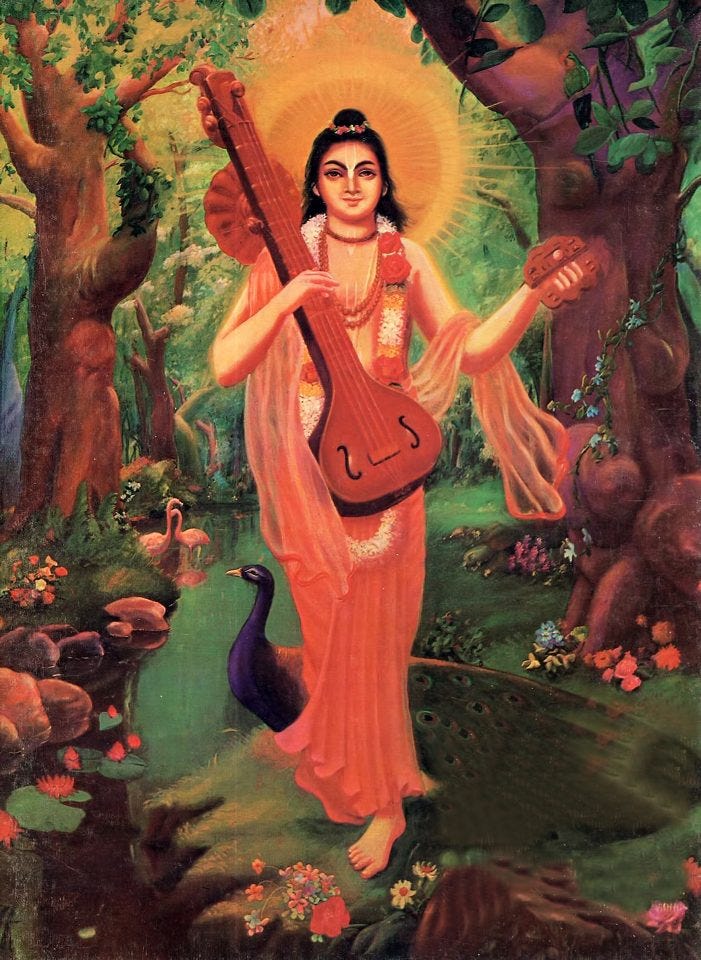
Aum Namo Narayanaya!
NARADA MUNI
Narada is the famous son of Brahma who chants the name of Lord Vishnu
– “Narayana- Narayana”, with every breath. This year 2026 his Jayanti is
celebrated on 2 nd May. His birthday is celebrated as ‘Patrakar Diwas’, as he
is considered to be the first journalist of the world. He has many devotees
in the world of communications; they revere him as their Guru.
He had the boon to travel to any of the three worlds, defying time and
space, at his own will.
He is a most complex and interesting character who is found in all
the yugas and in all the Puranas and Itihasas. He had a very complex
personality, difficult to understand. Outwardly he comes across as a happy
and playful character, but in reality, he was a very wise and
composed yogi. A legendary figure, this sage was an institution in himself!
He had actually been assigned the task of executing many miracles on
behalf of Lord Vishnu. He was the master of the 64 Vidyas and had
mastery over the Vedas and is supposed to be the one who instigated the
Ramayana and Bhagavad Purana. In fact, he was a mobile encyclopaedia.
He is known as the Messenger of the Gods. He was the first “patrakar,
reporter and public relations, management expert. His visits, though
seemingly random always had a purpose; he entered each scene, as if by
chance, stringing his lute and chanting the name of the Lord Narayana!
Although famous for appearing at the right moment at the right place, he
was equally famous for never keeping a secret. His habit of gossiping was
the root of many controversies and duels. But everything he did had a
divine purpose which was to bring about the greatness of his Master.
It is interesting to know his precedents.
In a much earlier life, as detailed in the Brahmavaivarta Purana, he was a
Gandharva (celestial singer) named Upabarhana.
With his beautiful face, attractive body, decorated with flower garlands and
sandalwood, his appearance was very pleasing to the women of the city.
Thus, Upabarhana was enmeshed in lusty desires. Once, there was
a sankirtana festival to glorify the holy names of the Supreme Lord, and the
Gandharvas were invited to take part. Upabarhana joined the festival,
surrounded by women, and began singing sexually oriented songs,
glorifying the demigods. The gods in charge of the affairs of the universe
cursed him for his behavior, saying "Because you have committed an
offense, you will be born as a sudra, as the son of a maidservant and
be denuded of all your beauty."
According to the Śrīmad-Bhāgavata Purana, Narada Muni was then born
as the son of a humble maidservant, living in a hermitage where many
sages used to come during the chaturmasya period to stay there and give
discourses to the ordinary people. The boy used to listen avidly to the
discourses and also clean the place after the sages had eaten. He gained
spiritual enlightenment by eating the remnants of their food (prasada) and
hearing their talks. The exact location of his dwelling is said to be a place
called Tholing, near present day Chamoli at a height of 12,200 feet. After
the rains the wandering sages moved on. He was most anxious to
accompany them but could not do so since his mother needed him. One
day she died of snake bite. He took her death as a sign of divine grace,
enabling him to leave behind all material bonds and seek the "Supreme
Absolute Truth". While meditating in the forest, he had a thrilling vision of
the Lord which delighted him so much that he begged the Lord to give it to
him again. He was told that he would never have that vision again in this
life but that he would be given another life of immortality and the ability to
sing the glories of the Lord all the time. This narrative highlights his
transformation from a state of lust and pride as a Gandharva to one of
absolute devotion and renunciation.
There are many incidents in his life which high point the effect he had on
the creation of some of our Puranas and Itihasas.
He is credited as being the one who was responsible for the sage Valmiki
to write the Ramayana.
Valmiki had once been a wretched dacoit and hunter called Ratnakar.
Once it happened that he came across Narada in the forest. It was his
nature to pounce on anyone who dared to go into that forest and rob them
and kill them if necessary. He dropped right in front of Narada and
threatened to kill him if he didn’t give over all his possessions. He was
surprised to see that the sage gave him a smile instead of the usual fearful
look which he used to get. So he asked him, “Aren’t you frightened of me?”
Narada said, “Why should I be afraid of you? What can you do to me?”
Ratnakar said, “I can kill you.”
Narada laughed and said, “You can only kill my body, you cannot kill me!”
Ratnakar was a bit puzzled. He was used to facing only two types of
animals in his life. One type would show fear and flee and the other type
would try to fight. But for the first time he saw something other than fear
and anger in this animal’s eyes. For the first time he saw love. He had
never seen it before – not even in his wife’s eyes.
Then Narada asked him, “Don’t you know that you are committing a lot of
sins by killing and robbing people? You’ll have to pay a price for all this.”
Ratnakar said he was doing it for the sake of his wife and children.
Narada asked him if they would be willing to share part of his karma and
accept the punishment. Ratnakar was sure they would. So Narada asked
him to go home and ask them if they would share a part of his
sinful karmas as they shared his spoils. He promised to stay there till he
returned.
Ratnakar rushed home and asked his wife and children and got the same
reply. She said it was the duty of a husband to look after his wife and the
children said it was the duty of a father to look after his children and
certainly they could not be expected to be punished for his sins!
Ratnakar was shocked and ran back to Narada and begged him to help
him. Narada told him to sit down and meditate on the mantra that he was
going to give him. He gave him the mantra - “Rama” but the poor untutored
hunter could not repeat it. So he told him to repeat the word “mara” which
means “tree” in Sanskrit. This he was able to do since he was always
cutting down trees. He sat down under a tree and started repeating the
word, “mara! mara”, which when repeated fast turns to “Rama! Rama!” Due
to his past samskaras he fell into a deep state of meditation from which he
didn’t wake up till many years later when Narada came back and found him
covered with an anthill. He broke open the anthill and released him and
said, “Awake Oh! Valmiki” The word for anthill in Sanskrit is “valmikam”.
Valmiki said he had no interest in going back to a life which was so
distasteful to him and would prefer to go back to his samadhi state. Narada
told him that there was an important task he had to undertake and that was
to write the story of a man who was a perfect human being.
Valmiki asked him about such a man and Narada gave him the name of
Rama which was the mantra he had been repeating all along.
Narada said, “You have to go and make an ashram near the Ganga. Very
soon you will find that a pregnant woman will come there threatening to
take her own life. You have to stop her and give her shelter in your ashram.
She is carrying the heir to the kingdom of the Ikshvakus. You will be given
divine insight to see the whole life of Rama and will thus be able to compile
a poem which will be the first poem in the world and will bring succour to
millions of people.
Valmiki reluctantly agreed and did as directed. This is how the Ramayana
was written by him.
However, there is another interesting story connecting Narada with the
Ramayana.
The Panchatantra story says that there was a very beautiful princess called
Srimati whose swayamvara (marriage by choice) was attended by all gods
and sages. The sages Narada and Parvata also attended the ceremony
along with all the gods. Both of the them had tried to look like Vishnu
himself. It is said that Vishnu created an illusion by which Narada had a
monkey’s face so she went and placed the wedding garland round Vishnu’s
neck. Totally humiliated Narada is said to have cursed Vishnu that he
would take a human form and suffer separation from his beloved wife and
depend on monkeys to fulfil the divine plan in his incarnation as Rama.
This story doesn’t ring true since we know Narada to be a true devotee of
Vishnu but Indian folklore weaves so many stories about so many things
that make for interesting reading. But it just shows what a great part
Narada played in the Ramayana.
He also had a great part in the making of the Bhagavad Purana. Once it is
said that he found the sage Vyasa – the writer of the Mahabharata and the
eighteen puranas to be in a despondent mood. When asked for the reason
Vyasa admitted that though he had written such a vast amount of literature,
yet he had not found mental peace.
Narada laughed and said, “O Sage! This is because you still have not
written about the greatness of the purnavatara – Sri Krishna. Only if you
write about him will you get peace of mind.
Vyasa realised the truth of what the sage had said and started writing the
Srimad Bhagavad Purana in which the exploits of Lord Krishna were
described in detail in the 10 th skanda. It was only after that, that he found
peace of mind.
Another interesting story found in the Bhagavad Purana is the one in which
he gave a mantra to the boy Dhruva. The very first of the royal dynasties
mentioned in the Purana is the dynasty of Swayambhuva Manu, the first
human being, son of Brahma. His son was the king called Uttanapada, who
had two wives, Suneeti and Suruchi. Suneeti means one who follows the
laws of good conduct and Suruchi is one who follows the dictates of the
lower mind. Suneeti was the elder wife and Dhruva was her son. Suruchi’s
son was called Uttaman. The king was totally infatuated by his younger
queen and quite disregarded Suneeti and her son. Once it is said the
Dhruva who was only a child of 5 once entered the royal assembly hall and
saw Uttama seated on his father’s lap. Dhruva also had a wish to sit on his
father’s lap and he went and clambered up. Immediately Suruchi threw him
down and told him that only her son had a right to sit on the king’s lap. The
child was terribly upset when he heard this and ran sobbing to his mother.
She comforted him and told him that only by worshipping the Lord would he
be able to assuage his grief.
Immediately the child marched outside and started to walk towards the
forest in order to do tapas. It was at this time that Narada decided to take a
hand. He stood before him on the path and asked him where he was going.
When Dhruva told him that he was going to the forest to do tapas to God,
Narada told him that he was too small for such a task and advised him to
return home and accept what fate had ordained for him. The child was
adamant and refused to be deterred from his resolution. Then Narada
initiated him into the famous “ashtakshari” (8-digital) mantra of Lord
Narayana – “Aum Namo Naraayanaaya”, which he himself used.
Dhruva went to the forest and did intense tapas, standing on one foot and
fasting without food and water for days until he became almost a skeleton.
At last Lord Narayana appeared before him in all his glory. The child
opened his eyes and was mesmerised by the vision in front of him. He
wanted to extol Him but was unable to do so. So the Lord touched his
cheek with his conch and a flood of words poured from his lips – a paean of
praise for the Lord. He was blessed with all worldly happiness and a place
in the heavens as well.
When the child returned he found that his father had regretted his hasty act
and was on his way to look for him. It is said that he became the king and
ruled for many years. When the time came for him to leave this world, he
was transported in a divine chariot and became the pole star which is
known as “Dhruva”.
Thus you will find that in every story that Narada appears to do some
mischief, it was only to create a situation that brought out the greatness of
his master –Narayana.
Thus he flits from loka to loka, eon after eon, striding over time and space,
strumming his lute and singing the greatness of his Lord – Narayana!
Narayana!
Aum Naradaya vidmahe,
Veena hastaya /dheemahi,
Tanno Narada Prachotayat
With gratitude to you Mataji! 🙏🏿💕