

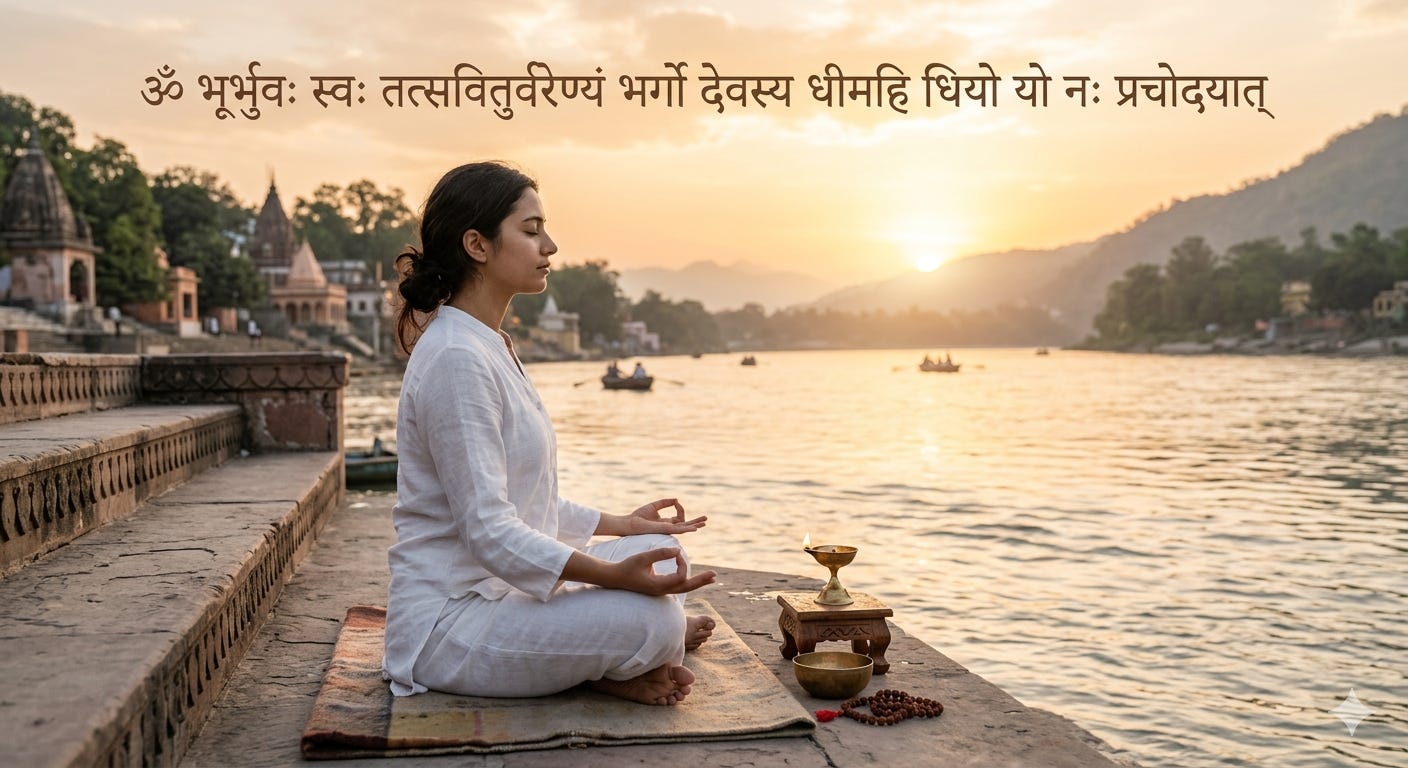
GAYATRI MANTRA
ॐ भूर्भुवः स्वः
तत्सवितुर्वरेण्यं
भर्गो देवस्य धीमहि
धियो यो नः प्रचोदयात्
Om Bhur Bhuvah Svah
Tat Savitur Varenyam
Bhargo Devasya Dheemahi
Dhiyo Yo Nah Prachodayat
We meditate on the divine radiance of the supreme Sun (Savitri), who illuminates all three realms — Earth, Atmosphere, and Heaven. May that divine light enlighten our minds.
The Vedas are the most ancient record of knowledge known to humanity. According to us, they are “anadi” or without a beginning and “ananta” or endless. The modern mind, which is conditioned by the western world, cannot grasp anything which is beyond time and space so we cannot understand what it means to be beyond time. What it means is that true wisdom has no beginning or end. The Vedas are a storehouse of wisdom encoded in mystic language or mantras which was revealed to the rishis of our culture when they were in a high state of consciousness. Though names of some rishis have been attached to the mantras, they did not claim to be the authors of the mantras. They said they “heard” the mantras. Hence this portion of the Vedas are known as “shruti” or “that which is heard.” The mantras are cosmic sounds which have ever existed in the “akasha” which is the subtlest of all the five elements and are available to anyone who has reached a high state of consciousness. These mantras are potent sounds, capable of producing many types of effects on the one who uses it.
The efficacy of a mantra depends totally on the correct pronunciation of the mantra which should be strictly done only under the guidance of a master or guru. It was never be learnt from a recording or book. It had to be passed down from mouth to mouth, from the guru to the shishya.
Hence the study of the Vedas was strictly an oral tradition. It was always passed down from master to student. If pronounced wrongly the mantra would give opposite effects, hence the need for a live guru who would pronounce it accurately and pass it on to an eligible student. The pressure required to correctly pronounce the syllables stimulates the tongue, throat and lips. Regular chanting induces relaxing brain waves and regulates the breathing.
The Gayatri Mantra is one of the most ancient mantras of the Sanatana Dharma and has its roots in the Rig Veda, the oldest and most sacred text in India, and cannot be dated according to us. The mantra is found in Mandala 3, Hymn 62, Verse 10 of the Rig Veda and was cognised by the great sage Vishwamitra. It is dedicated to the Sun deity, Savitur. It has great spiritual power and can illuminate the mind and awaken higher consciousness. “Gayatri” is actually the name of the ancient Vedic poetic meter in which the verse is chanted. The meter contains three lines of exactly eight syllables each (24 syllables in total). These sounds give a sort of sound therapy to twenty-four different sections of the body and mind. Gayatri is known as Vedamata or mother of all Vedas and is said to embody the entire revelation of the Vedas. The word “gayatri” itself means, “that which protects the singer.”
This mantra is a tool for awakening and expanding consciousness. It is a prayer for wisdom and enlightenment, invoking the divine light to illumine the practitioner’s intellect. The mantra’s deep spiritual resonance fosters a sense of connection with the Higher Self and the universe. Regular practice is believed to purify the mind and spirit, facilitating personal growth and spiritual awakening. By integrating the Gayatri Mantra into our daily routine, we can experience profound mental, emotional, and spiritual benefits, leading to a more balanced and enlightened life.
The mental repetition of the mantra also enhances concentration. The rhythmic chanting and the specific vibrations produced by it, help to calm the mind and reduce stress. Regular recitation can improve mental discipline, making it easier to maintain attention on tasks and improve cognitive function. Emotionally, the mantra fosters a sense of serenity and emotional stability. The very act of chanting can help to alleviate anxiety and promote a positive state of mind. Normally it is advised to repeat it, 108 times using a japamala or rosary containing 108 beads.
It might be interesting to look into the life of the great sage Vishwamitra (friend of the world) and how he came to cognise this greatest of all mantras. He was actually a great king. Once on his tour around his land, he happened to pass the ashram of his guru, the great sage Vasishta, who was a Brahmarishi – the highest type of rishi. He was given a warm welcome by the guru who insisted that he and his army should partake of a meal before proceeding on their tour of the land. The king was naturally intrigued and wondered at how a poor rishi could afford to feed his huge army. But very soon he was amazed to see that a huge repast of the most enticing dishes was spread before him and his hungry army, who ate their fill. The king immediately questioned the sage about his source. Vasishta replied that the devas had given him a cow called, “Surabhi” who was capable of fulfilling all one’s wishes. The king immediately said that such a precious thing should be possessed only by the king of the land since he was the one who had to feed countless people. What use was it to a poor sage! Vasishta politely refused and said that the cow belonged to him and would not go to anyone else. Vishwamitra was a ‘Kshatriya”. Patience was not in his blood. He immediately tried to take away the cow through force. But strangely enough the cow produced countless warriors of all types who defeated the king’s soldiers effortlessly! The infuriated king let fly deadly weapons at his guru and was amazed when the old man fended them off with the power of his wooden staff – the Brahma Danda or weapon of Brahma! Vasishta was a Brahmarishi – one who had gained enormous spiritual powers through “tapas” or intense austerity. His staff contained the power of Brahma – the creator.
It was only then that Vishwamitra realised that spiritual power was far superior to his physical power. He was a man of great resolution and decided then and there that he would do “tapas” and become a Brahmarishi. He meditated for countless years in the intense cold of the Himalayas, standing on one leg, eating nothing. At last Brahma was pleased and appeared before him and gave him the title of “Rajarishi” or the kingly saint. But Vishwamitra was not content with this. Once again, he started practicing great austerities for many years. At last Brahma appeared and asked him what he wanted. He said he wanted to become a Brahmarishi.
Brahma said that unless his heart was totally free of ego and wanted only the best for humanity, he could never be a Brahmarishi. Once again, the desperate king mediated for eons. His heart was rent asunder with the incredible pain and suffering of humanity. Now his tapas had extra force. He no longer asked for self-realisation but for alleviation of the suffering of humanity. Suddenly he started to hear a beautiful resonating sound and as he focussed on that sound his pain also reduced. Slowly the sound became more distinct and the syllables started to separate from the sound and arranged themselves into three lines, each containing 8 syllables. Thus, there were twenty-four syllables in all. Slowly he started to chant the sounds and realised that this was the mantra he was hoping for - one that would heal the suffering hearts of all humanity when chanted. This was the famous Gayatri Mantra. He opened his eyes and saw the form of his guru- Vasishta who was standing in front of him, holding the Brahma danda in his hands and looking at him with great love.
“O Vishwamitra!” he said, “Now you have truly become the friend of the universe. You are indeed a Brahmarishi. That universal power has used your anger to serve a great purpose. You have been given the most important gift to humanity – the Gayatri Mantra, which is so powerful that it is capable to take a person to the highest.”
This is the interesting story of the Gayatri Mantra which was revealed to the great sage Vishwamitra.
It is the most powerful incantation for invoking the divine, and attaining enlightenment. It is an important part of all Vedic rituals and spiritual practices. Unlike other types of specific prayers, it asks for no material wealth or favours. Instead, it is a focussed meditation on the divine light with a single-pointed request, “May that light of all lights guide and illuminate our intellect towards righteousness.” The translation of the Sanskrit words loosely means, “We meditate upon the radiant divine light of the adorable Creator. May this divine light inspire and guide our intellect.”
It should be chanted three times a day in the morning, noon and evening – when the sun is rising, when it is at its zenith and when it is setting. This is known as “trisandhya”. In the morning, it is dedicated to Lord Brahma and is called Gayatri, in the noon, it is dedicated to Lord Vishnu and is called Savitri, in the evening, it is dedicated to Lord Shiva and is called Saraswati.
Traditionally the mantra is first taught to children as part of the ceremony known as Upanayan - the sacred thread ceremony performed to mark the commencement of formal education in the Vedic tradition. In olden days it was performed when the child was 8 years old for the Brahmins, 11 years old for Kshatriyas, and 12 years old for Vaishyas. The Hindu educational system was totally lost in the many years of foreign invasions and came to an end with the British rule in which our traditional schools were shut down and the British type of education was insisted upon with the result that our ancient heritage came to be despised. It is only now that the Hindus are coming to realise the glory of their ancient culture and are trying to incorporate it in our schools.
A special day has been kept for worshipping the solar deity and renewing the effect of the mantra. This is known as the Gayatri Jayanti, observed yearly on the, shukla paksha Ekadashi in the month of Jyesta immediately following Ganga dusshera. This is the day on which the sage Vishwamitra revealed the sacred hymn to the world. It is believed that the mantra’s vibrations are at their peak on this auspicious day. Its universal appeal and timeless wisdom make it a central pillar of Hindu devotional practices and spiritual philosophy.
There is an elongated version of the mantra which brings an awakening of each of the seven chakras but this again should be learnt only with the help of a guru or teacher.
Now let us break down the mantra into its different parts and try to understand the meaning.
Aum Bhur Bhuvah Swaha, Tat Savitur Varenyam, Bhargo Devasya Dheemahi, Dhiyo Yo Nah Prachodayat
Word-by-Word Meaning:
“Aum” is the primeval sound, representing the universal consciousness.
Bhur is the earth -the physical realm.
Bhuvah is the mental realm (akasha).
Swaha is the spiritual realm (heavens).
Tat means - That.
Savitur refers to the Sun or divine light.
Varenyam is “worthy of worship”.
Bhargo is radiance or effulgence.
Devasya is “of the divine”.
Dheemahi means “we meditate upon”.
Dhiyo is intellect.
Yo: “who”.
Nah: “our”.
Prachodayat: “inspire or enlighten”.
The mantra invokes the divine light of the Sun to illuminate and guide our intellect through all realms of existence—physical, mental, and spiritual.
The mantra’s introductory syllables (Om Bhur Bhuvah Svah) are known as the Mahavyahritis, and represent the three planes of existence: the physical world, the mental world, and the spiritual realm.
There are many translations of the Gayatri Mantra highlighting different facets of its profound meaning, focusing on the invocation of the divine light to enlighten and guide our intellects. The mantra transcends the physical, mental, and spiritual realms, and is a tool for awakening and expanding consciousness. It is a prayer for wisdom and enlightenment, invoking the divine light to illuminate the intellect. It fosters a deep connection with the higher self and the universe. Regular practice purifies the mind and spirit, facilitating personal growth and spiritual awakening. By integrating the Gayatri Mantra into our daily routine, we can experience profound mental, emotional, and spiritual benefits, leading to a more balanced and enlightened life.
It enhances concentration. The rhythmic chanting and the vibrations help to calm the mind and reduce stress. Regular recitation can improve mental discipline, making it easier to maintain attention on tasks and improve cognitive function. Emotionally, the mantra fosters a sense of serenity and emotional stability. The very act of chanting can help to alleviate anxiety and promote a positive state of mind. Normally it is advised to repeat it, 108 times using a japamala or rosary containing 108 beads.
Later on, different Gayatri mantras were given by sages for each of the deities. Since the word “gayatri” denotes a Vedic metre, all these mantras are composed of three lines of eight syllables that count up to twenty-four syllables in total.
May our Hindu children once again learn to chant this mantra at the appropriate age so that our culture will once more flourish in its pristine form.
Aum Tat Sat