

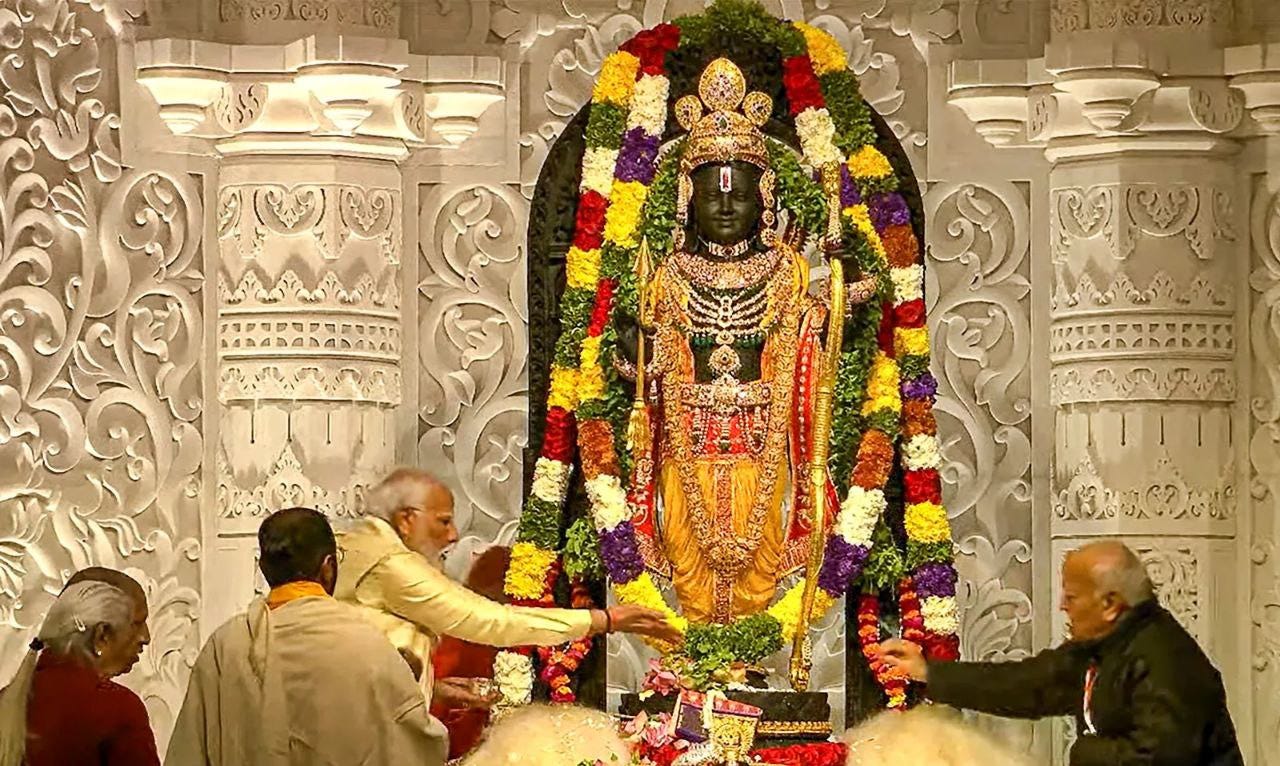
Ayodhya – the city of Rama, the capital of the Ikshwaku kingdom-the stage on which was played the drama of the life of the Prince of the clan of Raghu. In Bharat, history is a river that flows down from immemorial times to the present day. The past never died in India. It was woven into our present. Despite centuries of neglect, after innumerable efforts by foreign invaders to stamp out our history and rebuild on top of it, they never succeeded. The culture is imbedded into the very earth on which it flowers like grass seeds that lie dormant and sprouts up when the first drops of rain, fall. The wheel of Time moves slowly but it moves inexorably.
After seven thousand years of suppression and depression the truth has flowered and today Ayodhya stands with the flag of the Ikshavaku kingdom flying with pride over the palace of its prince Rama who was driven out on the day of his coronation; who returned in triumph after subduing the rakshasic forces and who was crowned as the king of the Ikshvakus. Rama Rajya or the rule of Rama has been acclaimed as being the most dharmic civilization that has ever existed. There was never a need for external enforcement or punishment because everyone obeyed the cosmic law of Dharma- satyam and ritam without any external pressure.
Our recent visit to Ayodhya was a long walk down the passage of time. The moment we landed on the holy land of Ayodhya, I was wafted back 7000 years back to the time when Rama, Prince of the Ikshvaku dynasty became king of Ayodhya, the ancient capital of the kings of the Surya Vamsa whose lineage was reckoned from the Sun God himself. What a lot of history did the stones of Ayodhya hide. I bent down and touched the holy ground and was wafted to the time when the young prince was banished to the forest for a period of fourteen years on the eve of his coronation! Only in Bharat do we realise that time is just a concept of the mind.
With head held high he walked away from the city of his birth, followed by his faithful wife and brother. But the citizens guessed that their beloved prince was leaving them and all of them followed him determined to endure the exile of their beloved prince. He was forced to leave them in the middle of the night so that they could go back to the comfort of their own homes for he knew that he would not be able to support them. They returned to a dead city in which there was no music or laughter during the fourteen years of exile which their prince had to go through. All of them slept on the floor, and ate the bare minimum for they knew that their prince was eating only roots and fruits from the forest!
His cherished brother Bharata, for whose sake he had abandoned the throne refused to set foot into the city and stayed in Nandigram where he worshipped his beloved brother’s footwear and lived the life of a monk!
Who was this person called Rama who could evoke such a sense of loyalty and love in all who met him?
The story of his life has exerted a universal appeal to all those who have read it. What is the greatness of Rama that he could have cast a spell over a whole continent which has lasted for 7000 years? His greatness lies in the fact that his life was based on certain eternal verities that appeal to the best in human nature. Indeed, these values have such a universal appeal that the character of Sri Rama has risen above the limits of sect, religion, race, and country. Obviously, it is a tale that is capable of touching the very depths of the human mind and heart.
The Ramayana may be an ancient chronicle, but it has deep meaning, even in modern times. We live in an age that is at a loss to know the meaning of human existence, and doubts the very existence of God. We are perplexed as to how we can act with righteousness when the whole world seems to have gone mad, when the meaning of truth and love cannot be found, and when hate and self-interest seem to be the only rules of conduct, from the highest to the lowest. Answers to these perplexing questions can be found in the Ramayana, for human nature, as such, has hardly changed through the years. Situations may change, avataras come and go, but human nature remains the same. However, the individual can and must change if society is to progress, and the characters found in this book are worthy of emulation. Our lives may well take a turn for the better when we read of the heroic way in which Rama and Sita faced the trials and tribulations of their lives.
Herein lies the greatness of Rama. In Rama, God took on a human form with all its frailties in order to show us how our aspirations for a dharmic life can be fulfilled. In him we see how we can surmount our frailties and become divine, if we are prepared to completely subjugate the ego, live only for the good of the world, and act in consonance with the duties and obligations of our particular position in society. Rama is the portrait of a man who shakes off the limitations of mortality and becomes divine by strict adherence to truth and honour. He has all the qualities of the average man—attachments, desire, anger and love, compassion and serenity. The greatness of his character lies in the fact that he surmounted the obstacles in his character, perfected himself and became superhuman, putting his duty above all personal considerations. This type of perfection is available to all of us, however weak we may be. Hence the popularity of the Ramayana. Rama is an example to all men, as Sita is to all women, and each one of us in reading their story can identify with them and try to perfect our own character as they perfected theirs.
Another endearing feature of the Ramayana, which for centuries has enthralled all who have read it, is that it is, above all, a love story, and love is a theme that never fails to touch a chord in even the hardest of hearts. But the Ramayana is a love story with a difference, because it deals with all facets of human love, both dharmic and adharmic: the love of a father for his son, of a son for his parents or a sibling, the love of a husband, wife, or friend, and finally even the love that is condemned by dharma—the passion for another man’s wife. All these are depicted in the Ramayana in the highest and most exalted manner.
According to Hindu tradition, the triple laws that govern the universe are rita, satya, and dharma. The first two are universal laws that, when translated to human life, are called dharma. One who bases life on this dharma would be true to himself and to the laws of the universe, and therefore such a person could well be called a perfect human being. Sri Rama is the personification of such a character.
He has been held up as the model son, brother, friend, and husband. He played each role to perfection, no doubt, but eventually he was forced to sacrifice each of those whom he loved so dearly. The Ramayana is a story of utter pathos that ascends to sublime heights of glory, the pinnacle of divinity, for no ordinary mortal could be so utterly selfless to the point of being considered heartless. Whatever role he played, he followed only this rule – “Am I acting according to dharma?” In following this path of fire, he burned himself time and again and was instrumental in bringing about the death of all his dear ones, beginning with his father. Each person he loved had to be sacrificed as a yajna to that implacable law of dharma, which he was bent on following to the bitter end.
At the end he left his beloved city of Ayodhya and departed for the higher realms from the ghat known as the Gupt ghat.
He was followed by the faithful citizens who could not bear to live without him. His was a life spent only for the sake of others—the people of Bharathavarsha, whom he had ruled and cared for, as a father cares for his children. What wonder that the Indian nation has upheld him as the glowing example of human perfection.
A reading of the Ramayana has the effect of cleansing us of our negative emotions and charging us with the moral fervor and grace of the great characters of the poem—Rama, Sita, Lakshmana, Bharata, Hanuman, and so on.
May the story of Sri Rama guide and inspire us to act with justice and honor at all times.
Many thousands of years have passed and the city of Ayodhya was taken over by the Muslim conquerors. At last, in this century, after the passage of seven thousand years, Rama has returned to his capital city and has been enshrined in all glory. Everyone in Ayodhya will greet you with only “Jai Sri Ram!” Every where you look you see scenes from his life. Even the street lights have a bow and arrow or the gada of Hanuman above them. The whole city is fragrant with the perfume of that beautiful soul who was forced to stay away from his beloved city for seven thousand years.
Hail to Ayodhya pati Ram!
Jai Sri Ram!
jai shri ram